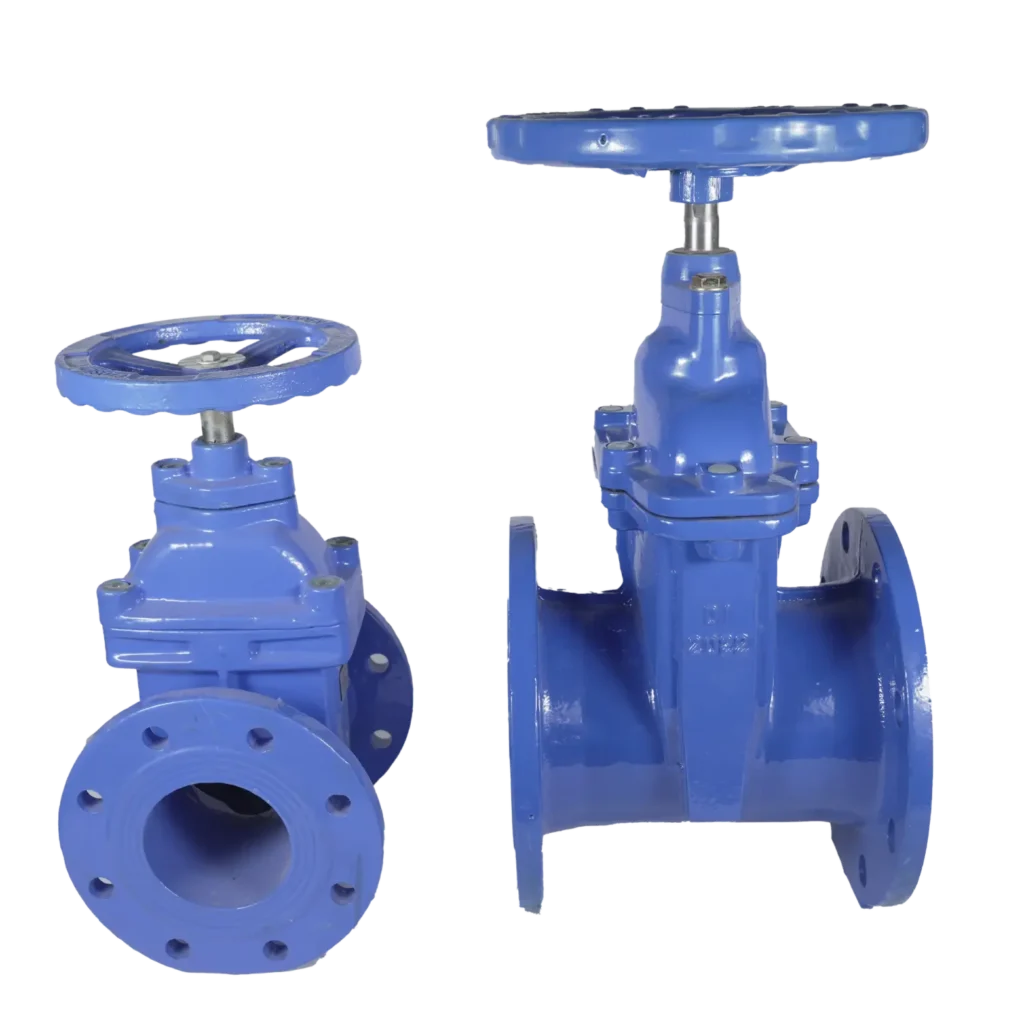
Gate Valves are linear-motion shut-off valves that feature a flat or wedge-shaped gate (disc) that controls fluid flow. When fully opened, the gate retracts into the bonnet, creating minimal flow resistance; when fully closed, it seals tightly against a pair of seats to stop flow. Gate valves handle a wide range of pressures and temperatures, making them a standard choice in industrial pipelines, waterworks, petrochemicals, and other process industries.

Pipeline isolation in upstream, midstream, and downstream operations. Suitable for crude oil, refined products, and natural gas lines.
Municipal water supply, sewage handling, and treatment plants. Controlling flow in large distribution networks or pump stations.
Process fluid isolation under moderate-to-high pressures and various chemical compatibilities. Refineries, chemical reactors, and power plants requiring reliable shut-off valves.
High-capacity water lines, cooling systems, and fire suppression mains. PN16 / Class-rated valves suitable for pressurized systems.
Bilge systems, ballast lines, and general fluid handling on vessels. Corrosion-resistant materials are often specified for marine environments.
Range from 2″ to 24″ (DN50 to DN600 nominal sizes). Accommodates both smaller process lines and large, high-flow pipelines.
PN16, Class 150 (#150), Class 300 (#300), and Class 600 (#600). Supports applications with varying pressures—from moderate municipal lines to higher-pressure industrial services.
Rising Stem vs. Non-Rising Stem (depending on bonnet design and clearance requirements). Wedge Gate (most common) or Parallel Slide Gate options. Bolted Bonnet, Pressure Seal Bonnet, or Union Bonnet designs per usage environment.
Body & Bonnet: Cast iron, ductile iron, carbon steel (WCB), or stainless steel (CF8/CF8M), depending on service fluid and temperature. Trim & Seat: Stainless steel, bronze, or other alloys for improved wear resistance and sealing performance. Gasket / Packing: Graphite or PTFE-based materials ensuring a reliable seal over a range of temperatures.
Manual Handwheel (standard) for small to medium sizes. Gear Operators or Actuators (electric, pneumatic, or hydraulic) for larger diameters or remote operation.
| Valve Type | Gate Valve (Wedge or Parallel Slide Gate) |
| Size Range | 2″ – 24″ (DN50 – DN600) |
| Pressure Ratings | PN16, Class 150 (#150), Class 300 (#300), Class 600 (#600) |
| Design Standards | API 600 / API 602 / ASME B16.34 / EN 1092-1 (for flanges), or equivalent |
| Body Material | Ductile Iron, Cast Steel (WCB), Stainless Steel (CF8/CF8M), Alloy Steel (optional) |
| Trim Materials | 13Cr, SS304, SS316, Bronze, or custom per fluid compatibility |
| End Connections | Flanged (RF or RTJ), BW (Butt Weld), SW (Socket Weld) depending on pressure class |
| Operating Temperature | Typically -29°C to +425°C (Carbon Steel); extends up to +540°C (Alloy Steel) |
| Leakage Class | API 598 / EN 12266 testing standards, typically zero leakage in fully closed position |
| Stem Sealing | Graphite packing or PTFE packing (size and temperature dependent) |
| Actuation | Handwheel, Gearbox, Electric/Pneumatic/Hydraulic actuators |
Reduces turbulence and erosion, especially beneficial for high-flow media. Minimizes energy costs by lowering friction losses.
A flexible wedge design handles thermal expansion better and adjusts to minor seat misalignments. Solid wedge suits high-pressure, large-size valves where robust disc strength is needed.
Many models include a backseat feature in the bonnet to facilitate packing replacement under line pressure (depending on valve design and safety protocols).
Guides along the body to ensure smooth and precise travel of the disc, preventing seat damage.
Secure threads and stuffing box design minimize leakage risk and stem blowout.
Search by Keywords / Part Name or Application